
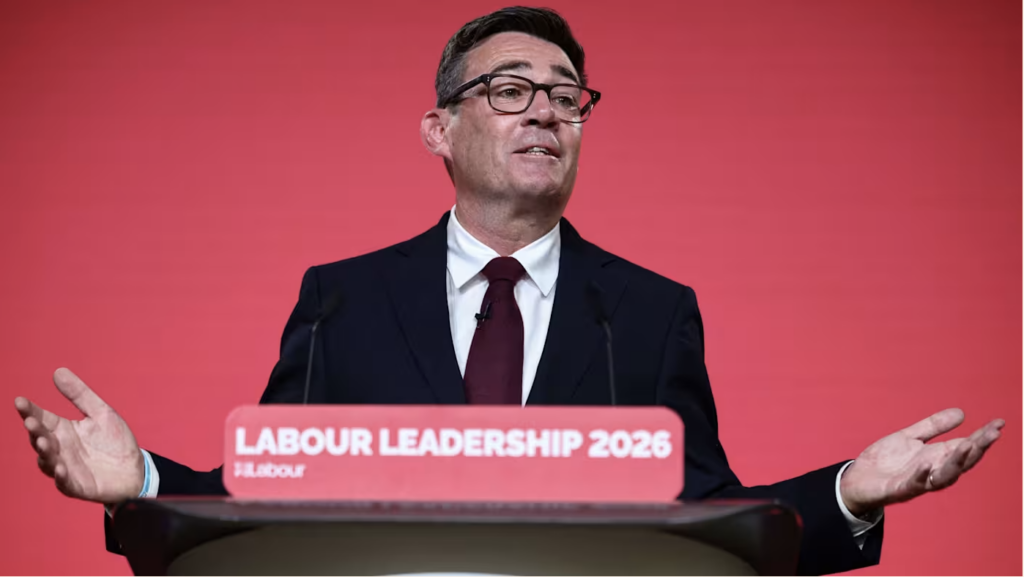
Former Greater Manchester mayor Andy Burnham returned to Westminster last month after winning the Makerfield by-election © Henry Nicholls/POOL/AFP/Getty Images
Andy Burnham promised to be a “pro-business” prime minister and to “take power back from Westminster” as he was crowned leader of the ruling Labour Party on Friday. In a speech in central London, the incoming premier told voters that Friday represented “the most significant change moment in our politics in 40 years” and that they should expect “a return of the Labour they once knew”. Burnham’s coronation as Labour leader was a formality: no one else stood against the former Greater Manchester mayor after Sir Keir Starmer agreed to step down as prime minister. He will become PM on Monday, when he is expected to name his cabinet. On Friday, he repeated his argument that “Britain took a series of wrong turns in the 1980s” by centralising political power and privatising essential infrastructure. Burnham wants greater state control of utilities, in particular troubled Thames Water. However, he also insisted: “Make no mistake everybody, I will be a pro-business leader of the Labour Party as I was a pro-business mayor of Greater Manchester. We turn places round together and that is the way.”
Burnham sought to answer scepticism about his rushed preparations for Number 10, insisting: “I am ready . . . I have a plan.” He added that he had not yet taken decisions on his top appointments but would do so soon. He also attempted to see off criticism about his focus on Manchester and the north, promising that his tour of the country this summer would include “all parts of the UK, definitely in the south”. He said he would start by visiting Gravesend on Friday. He set out five promises to the public: to overhaul the culture within government and end factional infighting; to “build a new politics” that ends party point scoring; to “set a direction that is distinctively Labour”; to be a leader for “all places” in the UK; and to pursue his devolution agenda. In a veiled nod to criticism of Starmer, who was accused of taking an expedient rather than values-rooted approach to politics, Burnham said: “I know what I believe after 25 years as an elected Labour representative . . . I won’t change. I have a style, it’s my style. I’ll always stay close to the ground, close to the people.”
Shabana Mahmood, in her role as chair of Labour’s national executive committee (NEC), confirmed Burnham’s victory on stage at the special party conference, conceding that it was “hardly a nail-biter”. He received nominations from all 11 Labour-affiliated trade unions, all the party’s affiliated socialist societies and 379 Labour MPs. Mahmood, currently home secretary, is expected to be his pick for chancellor of the exchequer, replacing Rachel Reeves. Starmer’s premiership unravelled after he failed to halt a slide in Labour’s polling and suffered a devastating series of setbacks in the May elections in the Scottish parliament, Welsh Senedd and English councils. Burnham, who plotted for months to return to Westminster, stood in a by-election in Makerfield and easily defeated Reform UK. On his return to the House of Commons he soon forced Starmer to step aside.
Written & Edited by: Jim Pickard and Lucy Fisher in London
Link to the article: https://www.ft.com/content/8cbd0b07-d0db-4c1a-a985-c495bd7168b8?syn-25a6b1a6=1&