
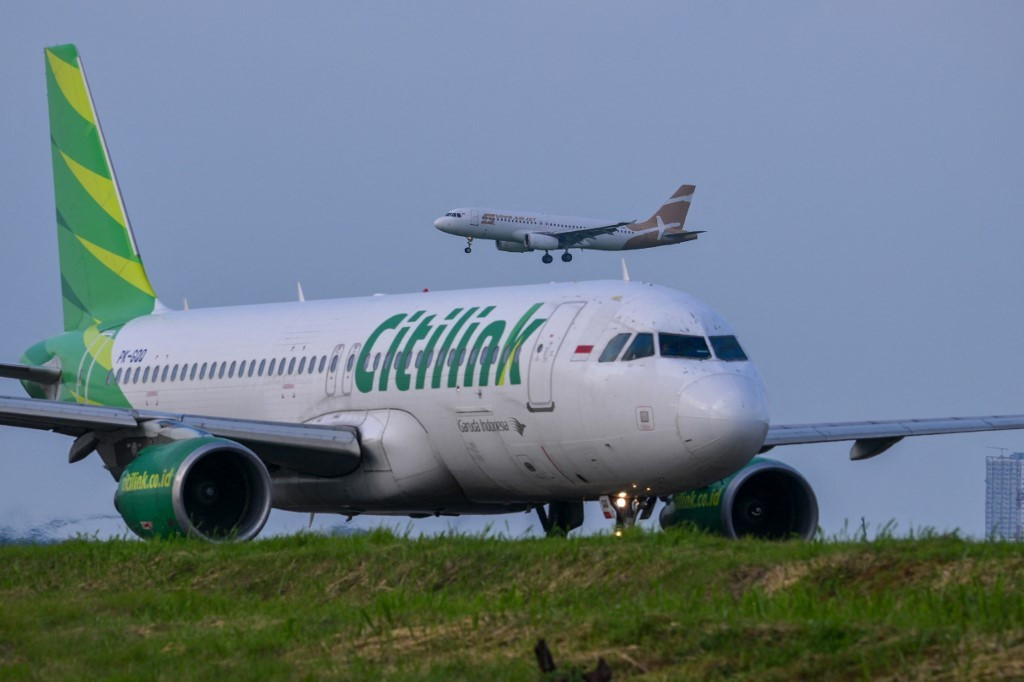
A plane bearing the livery of low-cost airline Citilink taxis down a runway on Jan. 10, 2025, as a plane operated by ultralow-cost carrier Super Air Jet lands on a runway at Soekarno-Hatta International Airport in Tangerang, Banten. (AFP/Bay Ismoyo)
Flag carrier Garuda Indonesia expanded the fleet of its low-cost subsidiary Citilink Indonesia to 43 operating aircraft by the end of June, up from 25 in the same period last year, as part of its transformation efforts backed by state asset fund Danantara. According to Citilink, the fleet expansion is part of Garuda’s strategy to strengthen overall capacity, particularly in the low-cost carrier (LCC) segment, although the budget airline did not disclose details of the scheme. “This step has strengthened Citilink’s operational capacity in expanding connectivity, boosting productivity and flight networks, as well as in capturing growth opportunities in the national LCC market,” the airline said in a statement published on Thursday. In the same statement, Citilink president director Darsito Hendroseputro said expanding the fleet reflected real progress in its transformation agenda, in line with Garuda’s ongoing strengthening efforts. “With the strategic support of Danantara in the transformation of Garuda Indonesia Group, we can accelerate aircraft readiness and improve operational capacity to accommodate growing public mobility,” Darsito said.
He added the fleet expansion had laid the foundation for the airline to improve competitiveness in the LCC market as well as expand interregional connectivity and provide safe, reliable and punctual air transportation services. Citilink recorded a 21 percent rise in average daily flights in the first half of the year to 221, compared to 183 flights in the second half of 2025. During the first six months of 2026, the airline also resumed operations on several routes, including between Halim Perdanakusuma International Airport in East Jakarta and Minangkabau International Airport in Padang, West Sumatra, as well as Sultan Syarif Kasim II International Airport in Pekanbaru, Riau. It also resumed services between Makassar in South Sulawesi and Palu in Central Sulawesi as well as between Jakarta and Malang, East Java. Citilink said resuming these routes was part of its strategy to develop more “adaptive and productive networks”, which it expected would boost interregional connectivity and support tourism growth and regional economies. The airline is also set to resume its services on Aug. 17 at Husein Sastranegara International Airport in Bandung, operating five domestic routes connecting the West Java capital city to its provincial peers Medan in North Sumatra, Palembang in South Sumatra, Denpasar in Bali and Surabaya in East Java, as well as Balikpapan in East Kalimantan.
Danantara’s capital injection into Garuda Indonesia Group was first unveiled in June last year as part of a wider funding package to support the flag carrier. The state asset fund, which oversees all state-owned enterprises (SOEs), provided an initial investment worth Rp 6.65 trillion (US$367.8 million) in the form of a shareholder loan to fund the national airline’s maintenance, repair and overhaul (MRO) business. The total funding package from Danantara is projected to reach $1 billion over several phases, with the first phase focusing on fleet maintenance and operational readiness for both the group’s full-service carrier (FSC) Garuda Indonesia and its low-cost subsidiary Citilink. The next phase will focus on optimizing operational and financial performance to support long-term business transformation.
Written by: Ni Made Tasyarani (The Jakarta Post)
This article was published in thejakartapost.com with the title “Citilink expands fleet to 43 aircraft, thanks to Danantara’s support”. Click to read: https://www.thejakartapost.com/business/2026/08/02/citilink-expands-fleet-to-43-aircraft-thanks-to-danantaras-support?utm_source=(direct)&utm_medium=home_popular.