19 January 2026
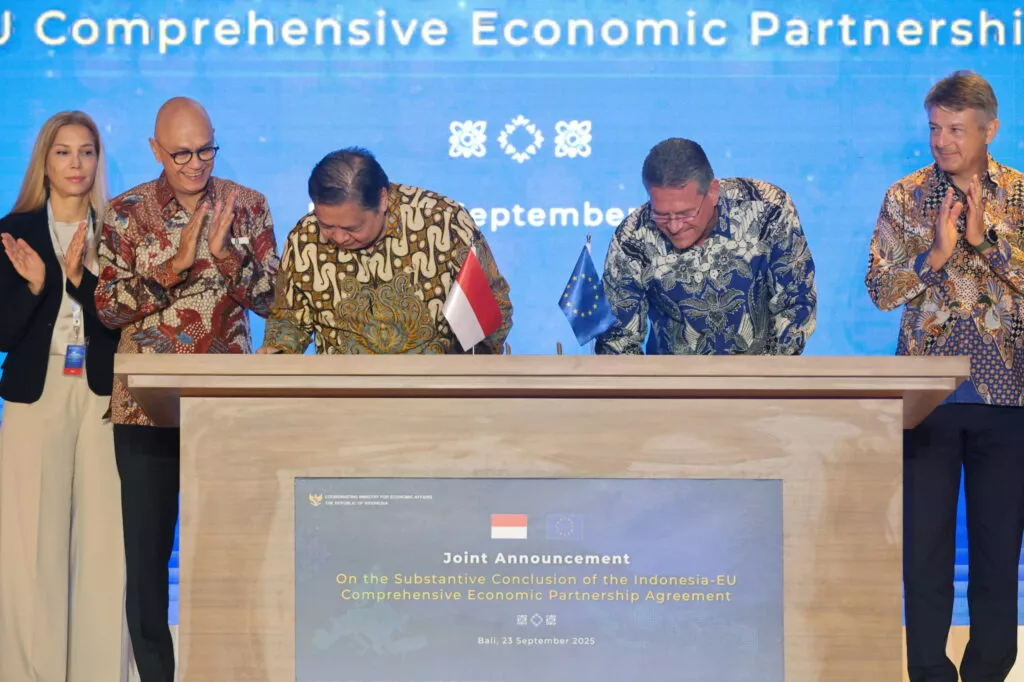
The signing of the Indonesia–EU Comprehensive Economic Partnership Agreement (IEU–CEPA) in September 2025 marked a significant achievement for both parties. Beyond trade, the agreement reaffirms Indonesia’s bebas aktif (‘free and active’) foreign policy and strengthens engagement with advanced markets even as Jakarta deepens ties with groupings such as BRICS. The agreement offers tariff reductions or eliminations across nearly all tariff lines.
But access to the EU market is no longer dictated by tariffs alone. As tariff barriers recede, rules of origin, sustainability, standards, traceability and due diligence will determine Indonesia’s gains from the agreement. With the IEU–CEPA set to enter into force in 2027, Indonesia faces the decisive question of whether its industries can adapt quickly enough to a world where standards and sustainability are a primary source of competitiveness. The answer will shape Indonesia’s ability to participate in a standards-focused global economy.
Sustainability issues are prominent in Indonesia’s trade with the European Union. Palm oil and its derivatives — one of Indonesia’s main exports to the European Union — illustrate the intersection of tariffs and regulation. Palm oil tariffs will be eliminated when the agreement enters into force, but palm oil exports will still face regulatory barriers that originate outside the agreement. The IEU–CEPA provides a basis for cooperation between both parties’ sustainability assurance schemes, such as the EU Deforestation Regulation (EUDR) and the Indonesian Sustainable Palm Oil scheme.
One of the EUDR’s requirements is that land used to produce covered commodities has not been converted from forest to agricultural use after 31 December 2020 and that compliance is verified. The European Union classifies Indonesia as ‘standard risk’ rather than ‘low risk’. This classification means higher compliance costs, since exporters must undertake full due diligence, unlike those in ‘low risk’ countries, which benefit from simplified procedures. The IEU–CEPA provides a platform for further cooperation and a pathway for Indonesia to seek a lower risk classification. Joint cooperation to improve traceability systems and deforestation monitoring, alongside greater interoperability between Indonesian Sustainable Palm Oil and EUDR due-diligence requirements, could strengthen the case for a future reassessment of Indonesia’s risk classification.
The core challenge is whether Indonesian industry has the capacity to meet these requirements. While larger producers, such as members of the Indonesian Palm Oil Association, say they are ready to meet them, 38 per cent of the palm oil area is still managed by smallholders. Cocoa, coffee and rubber are also predominantly managed by smallholders, with shares exceeding 90 per cent. These producers face similar challenges in complying with the EUDR, including traceability in remote areas and limited enforcement capacity.
A similar challenge arises with the IEU–CEPA’s rules of origin, which determine whether tariff preferences translate into real market access and whether Indonesian exporters can access them in practice. Often viewed as mere technicalities, these provisions dictate the required depth of domestic value-added processes and serve as a critical dividing line in modern trade. They reflect not only compliance capacity but also industrial readiness.
One of the IEU–CEPA’s origin rules for the textile and apparel sector requires that garments undergo key stages, such as weaving and making-up, within Indonesia or the European Union. In practical terms, a firm that imports yarn and turns it into fabric and clothing can qualify. But if an Indonesian firm imports fabric and manufactures apparel from it, it would not qualify for preferential tariff treatment under this rule.
This example illustrates the broader challenge for Indonesia. It needs to map which industries already meet the origin thresholds and which do not. Where gaps exist, strategies to upgrade, partner or restructure supply chains will be key to leveraging the IEU–CEPA. Those choices will determine which sectors gain a foothold in the European Union and which are effectively shut out despite the promise of ‘98 per cent tariff elimination’.
Both cases indicate that the IEU–CEPA’s benefits will not be automatic. They will depend on whether Indonesian industry can meet EU rules and standards — a question of industrial capability. The ability to strategise and meet those standards quickly will shape who wins and who loses under the IEU–CEPA.
Vietnam, which has had a free trade agreement with the European Union since 2020, has faced the stringent requirements of EU standards and rules of origin. Despite these challenges, the EU–Vietnam Free Trade Agreement (EVFTA) has strengthened bilateral trade. Between 2019 and 2024, EU–Vietnam trade increased from 45.6 billion euros (US$53.1 billion) to 67.1 billion euros (US$78.2 billion) — a 47 per cent increase. These figures may rise further as tariffs on Vietnamese exports are gradually phased out.
More importantly, the EVFTA catalysed reforms to Vietnam’s policy and legal systems to meet EU standards — an approach that Indonesia can replicate. The EVFTA figures suggest that if Indonesia adapts quickly, the diplomatic success of the IEU–CEPA’s signing can translate into real economic benefits.
The IEU–CEPA represents more than a diplomatic milestone. It is a roadmap for Indonesia’s maturation in standards-based trade and industry. The IEU–CEPA will not automatically open the EU market to Indonesia, but it will test whether Indonesia can become the kind of economy that Europe is willing to admit.
This article was made by Ichfan Ramadhan, EastAsiaForum
The views expressed in this article are the author’s own and do not represent the views of their employer.